
The main factors affecting the service life of long spouts and the ways to improve their service life
author: XINTAI
2025-06-26

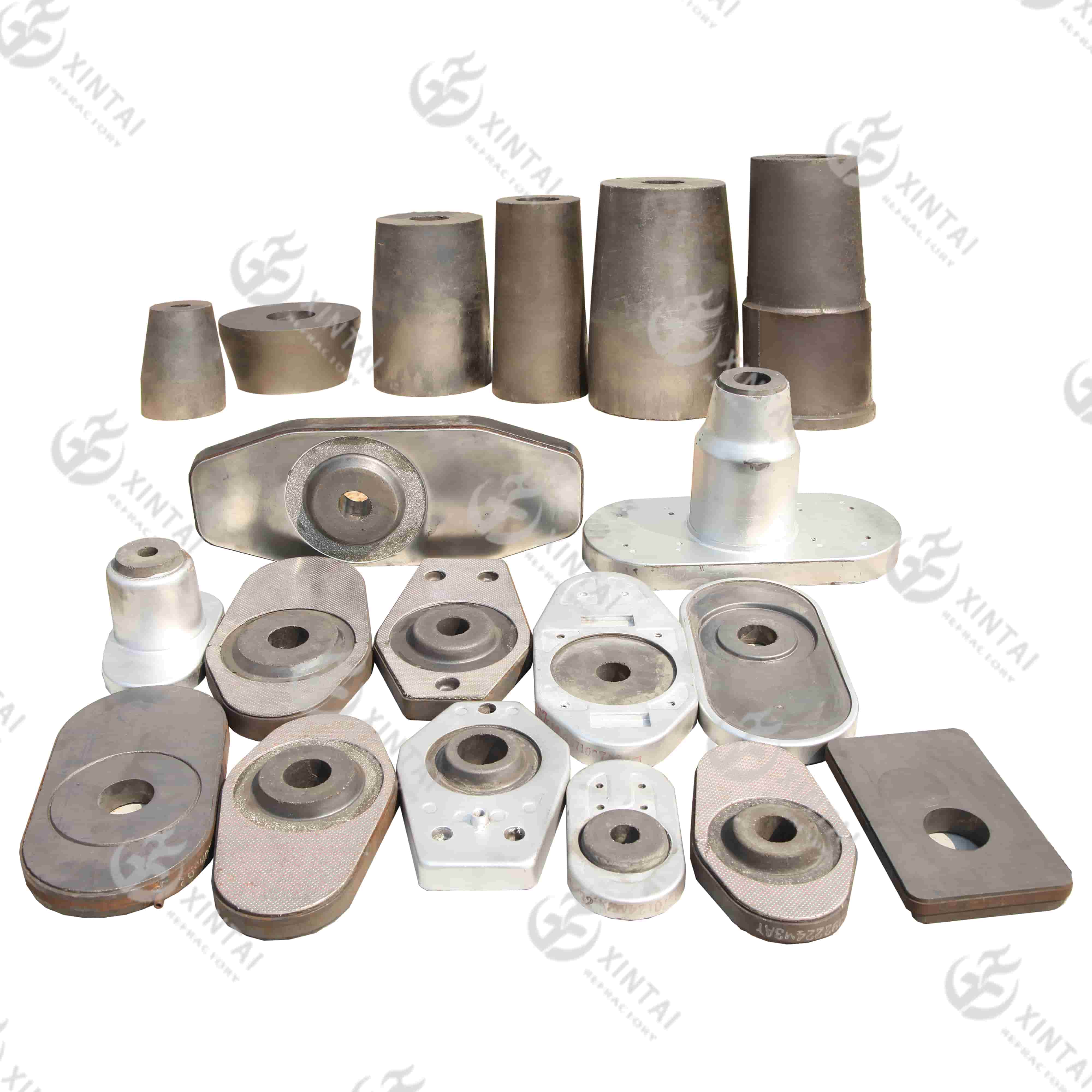
1. Ways to increase the service life of long water outlets
Some scholars have conducted research on the general relationship of one-to-one without other complex factors that change the relationship, and pointed out that there is a direct or inverse relationship among various performance indicators of refractory materials. To improve one of the performances while reducing the others. The relationship between porosity and thermal shock resistance is an example. When porosity increases, there are more vacancies in the microstructure that prevent crack propagation, thus improving thermal shock resistance. When porosity decreases, thermal shock resistance also decreases (i.e., in a proportional relationship).
Some scholars have conducted research on the general relationship of one-to-one without other complex factors that change the relationship, and pointed out that there is a direct or inverse relationship among various performance indicators of refractory materials. To improve one of the performances while reducing the others. The relationship between porosity and thermal shock resistance is an example. When porosity increases, there are more vacancies in the microstructure that prevent crack propagation, thus improving thermal shock resistance. When porosity decreases, thermal shock resistance also decreases (i.e., in a proportional relationship).
2. Optimization of carbon content at the long outlet
The optimization of particle size composition plays an important role in the formulation design of long spouts. The particle packing theory generally includes the close packing of discontinuous-sized particles and the close packing of continuous-sized particles. The theory of compact packing of discontinuous-sized particles has been proposed. They believe that the closest packing is formed when small particles precisely fill the gaps between large particles. Then, the expression for multi-particle discontinuous size packing is expressed by an equation, as shown in the formula (CPFT⁄100=(γlogD - γlogDs)⁄(γlogDl - γlogDs).
In the formula: CPFT represents the cumulative percentage of the mass of raw materials below a certain particle size grade, γ is the ratio of the mass of particles of adjacent two particle size grades, D is the particle size, Ds is the particle size of the smallest particle, and Dl is the particle size of the largest particle.
Andreas Sen proposed the theory of compact packing of continuous-sized particles. He believed that the particle distribution forms were the same, that is, statistically similar, and the same was true when the number of particles increased further. This theory is expressed by an equation, as shown in the formula (CDFT⁄100=(D⁄Dl)q).
In the formula, q is a value, representing the particle size distribution coefficient. By comparing the above two formulas, in equation (2), there is no limit on the minimum particle size, and the minimum particle size can be infinitely small. The idea of finite minimum particle size was introduced and the Andreassen equation was modified, as shown in the following formula.
The optimization of particle size composition plays an important role in the formulation design of long spouts. The particle packing theory generally includes the close packing of discontinuous-sized particles and the close packing of continuous-sized particles. The theory of compact packing of discontinuous-sized particles has been proposed. They believe that the closest packing is formed when small particles precisely fill the gaps between large particles. Then, the expression for multi-particle discontinuous size packing is expressed by an equation, as shown in the formula (CPFT⁄100=(γlogD - γlogDs)⁄(γlogDl - γlogDs).
In the formula: CPFT represents the cumulative percentage of the mass of raw materials below a certain particle size grade, γ is the ratio of the mass of particles of adjacent two particle size grades, D is the particle size, Ds is the particle size of the smallest particle, and Dl is the particle size of the largest particle.
Andreas Sen proposed the theory of compact packing of continuous-sized particles. He believed that the particle distribution forms were the same, that is, statistically similar, and the same was true when the number of particles increased further. This theory is expressed by an equation, as shown in the formula (CDFT⁄100=(D⁄Dl)q).
In the formula, q is a value, representing the particle size distribution coefficient. By comparing the above two formulas, in equation (2), there is no limit on the minimum particle size, and the minimum particle size can be infinitely small. The idea of finite minimum particle size was introduced and the Andreassen equation was modified, as shown in the following formula.

The maximum filling density can be achieved by using discontinuous particles, but there are particle segregation and uneconomy in actual production. Selecting continuous particles with reasonable gradation and adjusting the proportion of each particle gradation to achieve a high filling density is undoubtedly a better method. When the particle gradation conforms to the closest packing, the bulk density of the formed material is the highest. Therefore, by adjusting the particle size distribution of the material, the performance indicators such as porosity, bulk density, and flexural compressive strength of the material can reach the required range, obtaining materials with excellent thermal shock resistance and good erosion resistance.
Research results show that in order to ensure the high thermal shock stability of the "three major components" in continuous casting, a large amount of flake graphite (>20%) is usually added. The larger the particle size ratio, the worse the uniformity of the material will be, the more likely it is to form a graphite zone, and at the same time, the greater the risk of cracks at the contact interface between coarse particles and graphite, thereby reducing the thermal shock stability of the sample. However, When the amount of fine powder is too large, due to the low strength and the easy propagation of cracks, the thermal shock stability of the sample will also become poor. In terms of improving thermal shock resistance, the optimal particle size composition is a ratio of aggregates to fine powder of 40/60
Research results show that in order to ensure the high thermal shock stability of the "three major components" in continuous casting, a large amount of flake graphite (>20%) is usually added. The larger the particle size ratio, the worse the uniformity of the material will be, the more likely it is to form a graphite zone, and at the same time, the greater the risk of cracks at the contact interface between coarse particles and graphite, thereby reducing the thermal shock stability of the sample. However, When the amount of fine powder is too large, due to the low strength and the easy propagation of cracks, the thermal shock stability of the sample will also become poor. In terms of improving thermal shock resistance, the optimal particle size composition is a ratio of aggregates to fine powder of 40/60
3. Select an appropriate amount of binder addition
The appropriate amount of binder added can obtain the appropriate porosity and strength indicators. It was studied that under the condition that the proportions of aggregates, fine powder, micro powder and graphite remained unchanged, resin was selected as the binder and granulated by a high-speed granulator. The influence of the resin addition amount on the granulation effect was studied through the screening analysis of the prepared mud materials, the observation of the scanning electron microscope morphology of the samples, and the time-ratio analysis of physical performance indicators. The results show that with the increase of the resin addition amount, the diameter and quantity of the pseudo-particles formed in the clay increase. The apparent porosity and bulk density of the sample are initially mainly affected by the granulation effect, and then gradually change to be affected by the resin addition amount. The compressive strength at room temperature and flexural strength of the sample show a gradually increasing trend.
The appropriate amount of binder added can obtain the appropriate porosity and strength indicators. It was studied that under the condition that the proportions of aggregates, fine powder, micro powder and graphite remained unchanged, resin was selected as the binder and granulated by a high-speed granulator. The influence of the resin addition amount on the granulation effect was studied through the screening analysis of the prepared mud materials, the observation of the scanning electron microscope morphology of the samples, and the time-ratio analysis of physical performance indicators. The results show that with the increase of the resin addition amount, the diameter and quantity of the pseudo-particles formed in the clay increase. The apparent porosity and bulk density of the sample are initially mainly affected by the granulation effect, and then gradually change to be affected by the resin addition amount. The compressive strength at room temperature and flexural strength of the sample show a gradually increasing trend.
4. Introduce materials with a low coefficient of thermal expansion
A long spout without preheating was developed by adding fused silica and zircon mullite, etc., and its service life is between 4 and 7 hours. Based on the study of foreign technologies, advanced refractory raw materials such as Selon and special binders were adopted, and experimental development of manufacturing and firing processes that were compatible with the preparation technology was carried out. The contradiction between the thermal stability of long spouts and their erosion resistance and erosion resistance was solved, and the excellent comprehensive performance of non-baking long spout products was obtained. To enhance the thermal shock stability of aluminum-carbon long spouts, low-expansion refractory materials are generally added. Such as fused silica, zirconium mullite, silicon carbide, etc.
A long spout without preheating was developed by adding fused silica and zircon mullite, etc., and its service life is between 4 and 7 hours. Based on the study of foreign technologies, advanced refractory raw materials such as Selon and special binders were adopted, and experimental development of manufacturing and firing processes that were compatible with the preparation technology was carried out. The contradiction between the thermal stability of long spouts and their erosion resistance and erosion resistance was solved, and the excellent comprehensive performance of non-baking long spout products was obtained. To enhance the thermal shock stability of aluminum-carbon long spouts, low-expansion refractory materials are generally added. Such as fused silica, zirconium mullite, silicon carbide, etc.
What is the function of the tundish?
Refractories for iron ladle linings can't be destroyed without these 6 factors
Related Article
Understanding the erosion mechanisms that cost steel mills millions annually
The Hidden Battle: Why Your Slide Gate Plates Fail Prematurely in Steel Casting

Some common situations, causes and preventive measures of steel penetration, seepage and leakage in ladle sliding plates
Some common situations, causes and preventive measures of steel ladles

The tundish is a device used for the transition of molten steel between the molten steel ladle and the mold. The tundish plays a role of "connecting the upper and lower parts" after receiving the molten steel flowing into the continuous casting ladle. Its installation position is shown in the figure
What is the function of the tundish?

The main function of the molten iron ladle is to transport molten iron to the converter and electric furnace. In the process of transporting molten steel, the lining of the tank is mainly subjected to the following aspects of damage.
Refractories for iron ladle linings can't be destroyed without these 6 factors