
How can you easily achieve the tunnel kiln reducing atmosphere firing brick
author: Archie
2025-04-29
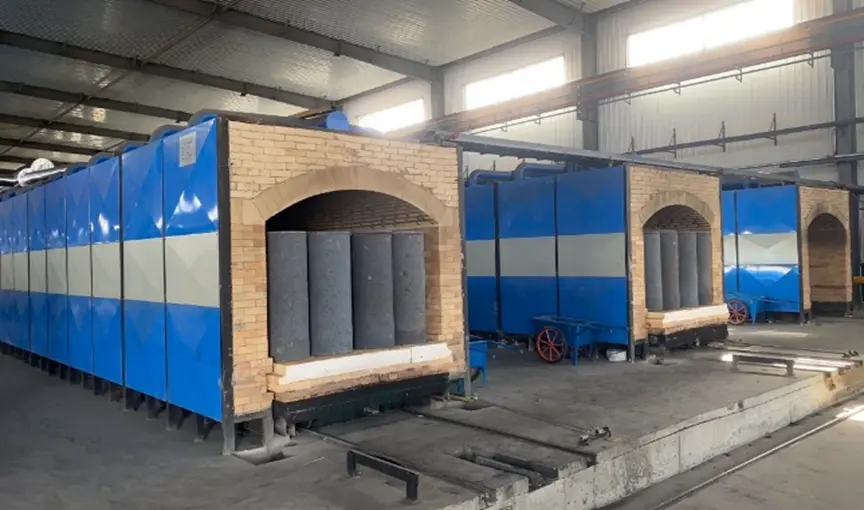
Tunnel Kiln Reduced Atmosphere Firing Process.
Under reducing atmospheres, sintered clay products can be produced in a wide variety of colours, and even a single product exhibits the interaction of multiple colours. It is possible to produce a wide range of colours that are popular in modern architecture. By controlling the reducing atmosphere, sintered brick and tile manufacturers can not only differentiate their products by their form properties, but also highlight the attractiveness of their products by changing various colours. Colour change is a property of the body itself and does not require the use of glazes or raw material additives.
The colour rendered after firing of this blank itself has the following characteristics.
1. The change of colour is continuous, and the degree of reduction can be controlled through reasonable operation and control of the reducing atmosphere, which can theoretically produce countless colour changes from light to dark.
2. This colour is from the inside out, bright and vivid, and will not change with the passage of time or the wear and tear of the product.
Reducing atmosphere firing products, the colour penetration obtained is high, but its sintering process is more complex than the ordinary oxidizing atmosphere process, the control precision is more demanding, and some special aspects must be considered. The next section describes how you can implement the measures required for reducing atmosphere sintering on the basis of a normal tunnel kiln.
1. The change of colour is continuous, and the degree of reduction can be controlled through reasonable operation and control of the reducing atmosphere, which can theoretically produce countless colour changes from light to dark.
2. This colour is from the inside out, bright and vivid, and will not change with the passage of time or the wear and tear of the product.
Reducing atmosphere firing products, the colour penetration obtained is high, but its sintering process is more complex than the ordinary oxidizing atmosphere process, the control precision is more demanding, and some special aspects must be considered. The next section describes how you can implement the measures required for reducing atmosphere sintering on the basis of a normal tunnel kiln.

1.Tunnel Kiln Reduced Atmosphere Firing Process
The firing zone of a tunnel kiln with an excess of fuel leads to a shortage of oxygen and the production of reducing gases such as CO. This is the reducing atmosphere. It is now customary to refer to a combustion gas with a CO content of less than 4 per cent as a weakly reducing atmosphere, and a CO content of more than 4 per cent as a heavily reducing atmosphere. In this case, the reducing gas will react with the iron oxide, CO takes away the oxygen in the iron oxide and converts it to CO2, and the iron is reduced. Of course, in the kiln combustion gas in the carbon particles also have a reducing effect, but the reducing effect of carbon particles than the reducing effect of CO is much weaker, because the role of carbon particles and iron oxide belongs to the role of solid-phase reaction, and CO and iron oxide belongs to the role of the gas phase and the solid-phase reaction, in the same conditions, the latter reaction is bound to be stronger than the former reaction. Therefore, the general control of the reducing atmosphere in the kiln is achieved by changing the CO content in the kiln.
In a conventional tunnel kiln, cooling air is blown into the kiln at the end of the kiln by means of an air forced convection system (backdraft fanner). Part of the air is re-entered into the flue gas discharge system at the bottom and top of the kiln where it is discharged together with the hot air. The other part of the air remains in the kiln and flows along the kiln aisles to the firing zone where it mixes with the flue gases from the burner zone. It is this oxygen-rich air that cancels out the reducing gases that continue to be formed in the firing zone, reducing the reduction effect considerably and causing the reducing atmosphere to ‘go out with the wind’.
It is therefore necessary to prevent this air flow to a large extent. In order to achieve this, an additional branch duct is required. Between the cooling belt extractor fan and the reduction zone the air is withdrawn and fed into the preheat zone for readjustment, which is at a temperature of approx. 450°C. This air can be used in the preheat zone. Air at this temperature can be used to preheat the brickwork in the preheating zone. With regard to the structural design of this branch pipework, several special technical characteristics have to be taken into account in order to be able to withstand the temperature requirements. For example, the use of a fume extractor fan with a high temperature resistance in the inner village, a pipeline with due regard to linear expansion and a suitable fan for forced air supply, these components need to be able to cope with high temperatures up to a maximum air supply temperature of 800C.
In a conventional tunnel kiln, cooling air is blown into the kiln at the end of the kiln by means of an air forced convection system (backdraft fanner). Part of the air is re-entered into the flue gas discharge system at the bottom and top of the kiln where it is discharged together with the hot air. The other part of the air remains in the kiln and flows along the kiln aisles to the firing zone where it mixes with the flue gases from the burner zone. It is this oxygen-rich air that cancels out the reducing gases that continue to be formed in the firing zone, reducing the reduction effect considerably and causing the reducing atmosphere to ‘go out with the wind’.
It is therefore necessary to prevent this air flow to a large extent. In order to achieve this, an additional branch duct is required. Between the cooling belt extractor fan and the reduction zone the air is withdrawn and fed into the preheat zone for readjustment, which is at a temperature of approx. 450°C. This air can be used in the preheat zone. Air at this temperature can be used to preheat the brickwork in the preheating zone. With regard to the structural design of this branch pipework, several special technical characteristics have to be taken into account in order to be able to withstand the temperature requirements. For example, the use of a fume extractor fan with a high temperature resistance in the inner village, a pipeline with due regard to linear expansion and a suitable fan for forced air supply, these components need to be able to cope with high temperatures up to a maximum air supply temperature of 800C.
2.Reducing Atmosphere Tunnel Kiln Control System
In the tunnel kiln reduction atmosphere firing process, the control of the following key processes is of the utmost importance and these parameters determine the success of the process: 1. Pressure regulation in the kiln 2. Flue gas ventilation regulation 3. Temperature regulation of the burner system 4. Cooling belt regulation and flue gas venting system regulation.
In order to obtain a reducing atmosphere, the pressure regulation in the tunnel kiln is very important and must be strictly monitored by the control system. Why? For example, once the pressure control system has started to regulate to a set pressure value, it usually slightly exceeds the set defaults. This leads to slight fluctuations in the pressure value, which in oxidation atmosphere firing do not cause any problems at all, but can lead to serious problems in reduction atmosphere firing processes, where the zero pressure surface can be shifted. Therefore, the usual control system is not applicable in the reduction atmosphere firing process. It is necessary to adjust the kiln pressure parameters according to the kiln car advance speed in real time by specifying commands in the computer console window. The zero pressure surface of the tunnel kiln's front and rear belts has a large impact on the kiln's reduction atmosphere firing system, which directly affects the displacement of the whole kiln's firing curve. Therefore, the preheat belt heat delivery system, the firing belt exhaust system, and the cooling belt heat extraction system should be accurately controlled to stabilise the pressure and to control the kiln to produce the optimum pressure balance suitable for the reduction atmosphere.
In order to obtain a reducing atmosphere, the pressure regulation in the tunnel kiln is very important and must be strictly monitored by the control system. Why? For example, once the pressure control system has started to regulate to a set pressure value, it usually slightly exceeds the set defaults. This leads to slight fluctuations in the pressure value, which in oxidation atmosphere firing do not cause any problems at all, but can lead to serious problems in reduction atmosphere firing processes, where the zero pressure surface can be shifted. Therefore, the usual control system is not applicable in the reduction atmosphere firing process. It is necessary to adjust the kiln pressure parameters according to the kiln car advance speed in real time by specifying commands in the computer console window. The zero pressure surface of the tunnel kiln's front and rear belts has a large impact on the kiln's reduction atmosphere firing system, which directly affects the displacement of the whole kiln's firing curve. Therefore, the preheat belt heat delivery system, the firing belt exhaust system, and the cooling belt heat extraction system should be accurately controlled to stabilise the pressure and to control the kiln to produce the optimum pressure balance suitable for the reduction atmosphere.
For the burner system, in order to ensure a certain CO gas content in the reduction zone, it is necessary to control not only the kiln pressure, but also the CO content. As we all know, the temperature of the reduction zone is not proportional to the fuel, in the case of incomplete combustion, the fuel increase or decrease will not cause sensitive changes in temperature, and sometimes there is a fuel increase or decrease inversely proportional to the temperature of the phenomenon, which will lead to monitoring system instrumentation misjudgment, and there is a vicious circle, and finally lead to the failure of the entire control loop, for this situation we take the control of the two parameters to To solve this problem, we adopt the control of two parameters. On the one hand, the temperature of the point is detected to control the fuel feed of the nozzle, and on the other hand, the atmosphere (i.e., CO content) of the point is detected to control the air intake of the spray gun. In this way, the temperature and atmosphere of the reduction zone can be controlled by detecting and controlling both points at the same time.
In order to obtain the reduction atmosphere, the high speed burner used is set to anoxic combustion mode. It is important here that the entire setup parameters of the burner are adjusted to the different conditions, so that real-time monitoring and control is achieved to ensure that the reducing atmosphere is maintained throughout the output range and that oxygen-rich combustion does not occur. Since this is usually not guaranteed by standard combustion technology, Honeywell has developed new burners and related components suitable for reducing atmosphere firing, i.e. air valves with servomotors, balanced pressure regulators with control lines, and matching valves and BCUs.
In order to achieve the required goal of a constant A-value over the entire output range. For this purpose, extensive testing was done, and combustion tests of various parameters were carried out on a burner test stand to create a self-regulating control burner. For example, the burner can adjust the burner output according to changes in kiln atmosphere pressure and temperature during the trolley process to keep the kiln's reduction atmosphere indicators constant.
In order to obtain the reduction atmosphere, the high speed burner used is set to anoxic combustion mode. It is important here that the entire setup parameters of the burner are adjusted to the different conditions, so that real-time monitoring and control is achieved to ensure that the reducing atmosphere is maintained throughout the output range and that oxygen-rich combustion does not occur. Since this is usually not guaranteed by standard combustion technology, Honeywell has developed new burners and related components suitable for reducing atmosphere firing, i.e. air valves with servomotors, balanced pressure regulators with control lines, and matching valves and BCUs.
In order to achieve the required goal of a constant A-value over the entire output range. For this purpose, extensive testing was done, and combustion tests of various parameters were carried out on a burner test stand to create a self-regulating control burner. For example, the burner can adjust the burner output according to changes in kiln atmosphere pressure and temperature during the trolley process to keep the kiln's reduction atmosphere indicators constant.
3.Construct
In terms of construction, special properties must be taken into account for kilns with reducing atmospheres. Population and outlet air curtains are important to protect the kiln from the outside world when kiln cars are entering and exiting. In order to retain the reducing gases in their rightful place, the kiln structure is sealed with a membrane in the kiln. The material chosen is PTFE, a material that can withstand temperature loads. A further heat-resistant material ensures the sealing between the individual membrane elements. The kiln car chassis area is cooled using a wheel cooling system. In order to maintain the seal between the kiln car and the kiln, the proven Sand Seal Curve Seal double end seal is used.
4.Concluding Remarks
In the case of reducing atmosphere firing, a deep cyan product colour can be obtained, with a high depth of colour penetration allowing for complete colouration. These products are now very popular in modern architecture. In the reducing atmosphere tunnel kiln, modern products with distinctive features can be produced continuously. Not only is the product's attractiveness emphasised by its shape, but it is also favoured by a wide range of customers for its unique visual appearance. Tunnel kilns for the firing of bricks in a reducing atmosphere can be easily realised by means of rational and scientific construction and the right choice of process.
What should I do when my tunnel kiln needs an overhaul?
The role of roller kiln kiln flaps and firewalls
Related Article

Refractory materials are the main building materials of glass melting furnaces, and they have a decisive impact on the quality of glass, energy consumption and even product costs. The development of glass melting technology largely depends on the advancement of refractory material manufacturing technology and the improvement of quality.
Selection of kiln type structure and lining refractory materials for glass melting furnaces

The cover of the electric furnace is a spherical structure with electrode holes and smoke exhaust holes. The outer ring part is called the main furnace cover, and the middle part is called the small furnace cover (also known as the triangular area). When loading materials, the furnace cover can be moved away.
Factors affecting the service life of refractory materials used for electric furnace covers

Overburning and lumping are common phenomena in the lime production process. They not only affect product quality but, in severe cases, can have a fatal impact on the production process, refractory materials of the kiln body and other equipment. This article analyzes the causes of overburning and tumor formation, general treatment methods for tumor formation, and preventive measures, effectively avoiding the occurrence of tumor formation.
Common causes of lumps in lime kilns and their solutions

A kiln is a space capable of generating high temperatures, and the materials that make up this space are called kiln construction materials. The construction materials should include two major categories: refractory materials and thermal insulation materials (or heat insulation materials). In addition, to enhance the structural strength of the kiln body, the materials used for furnace construction should also include common building materials (such as ash bricks, etc.) and metal materials, etc.
Don't know how to build a kiln or furnace? This article is enough