
Composition and properties of ramming material for glass kiln
author: XINTAI
2025-09-02
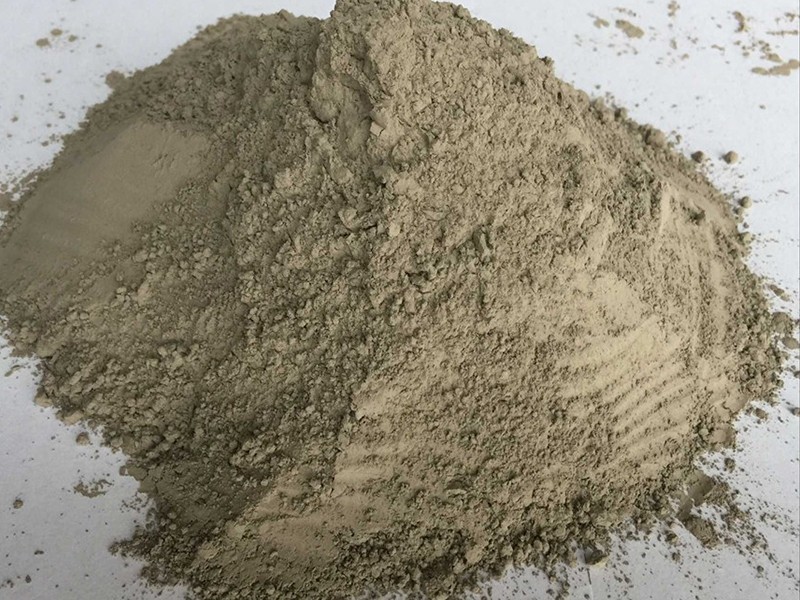
01. Composition
Ramming mass can be prepared from various refractory aggregates and powders depending on the intended use. The appropriate binder is also selected based on the refractory aggregate material and intended use. Some ramming masses do not use a binder, but only add a small amount of flux to promote sintering. Sodium silicate, ethyl silicate, and silica gel are commonly used as binders in acidic ramming mass. Aqueous solutions of magnesium chloride and sulfate, as well as phosphates and their polymers, are used in alkaline ramming mass. Organic compounds with high carbon content that form carbon bonds at high temperatures and temporary binders are also commonly used. Chromium ramming mass often uses Glauber's salt as a binder. High-alumina and corundum ramming mass often uses phosphoric acid and inorganic compounds such as aluminum phosphates, sulfates, and chlorides. When phosphoric acid is used as a binder, it reacts with the active alumina in the ramming mass during storage, forming a water-insoluble aluminum orthophosphate precipitate that solidifies and hardens. This precipitate loses its plasticity, making it difficult to work with. Therefore, to extend the shelf life of ramming materials, an appropriate preservative must be added to prevent or delay coagulation and hardening. Oxalic acid is commonly used as a preservative.
Ramming mass can be prepared from various refractory aggregates and powders depending on the intended use. The appropriate binder is also selected based on the refractory aggregate material and intended use. Some ramming masses do not use a binder, but only add a small amount of flux to promote sintering. Sodium silicate, ethyl silicate, and silica gel are commonly used as binders in acidic ramming mass. Aqueous solutions of magnesium chloride and sulfate, as well as phosphates and their polymers, are used in alkaline ramming mass. Organic compounds with high carbon content that form carbon bonds at high temperatures and temporary binders are also commonly used. Chromium ramming mass often uses Glauber's salt as a binder. High-alumina and corundum ramming mass often uses phosphoric acid and inorganic compounds such as aluminum phosphates, sulfates, and chlorides. When phosphoric acid is used as a binder, it reacts with the active alumina in the ramming mass during storage, forming a water-insoluble aluminum orthophosphate precipitate that solidifies and hardens. This precipitate loses its plasticity, making it difficult to work with. Therefore, to extend the shelf life of ramming materials, an appropriate preservative must be added to prevent or delay coagulation and hardening. Oxalic acid is commonly used as a preservative.
02. Performance
Ramming materials are typically used in areas that come into direct contact with the melt. Refractory materials must exhibit excellent volume stability, density, and corrosion resistance, so high-temperature sintering or electrofusion-melted raw materials are generally used. The maximum particle size of the ramming material depends on the construction method of the intended part, with a typical critical particle size of 8mm. Most ramming materials have low strength at room temperature before sintering, and some also exhibit low strength at medium temperatures. Good bonding is achieved only after heating and sintering. Refractory properties and resistance to melt corrosion can be enhanced through the selection of high-quality raw materials, proper mixing ratios, and careful construction. Besides high stability and corrosion resistance at high temperatures, the service life of ramming materials also depends largely on the quality of pre-use baking or initial sintering. Achieving a seamless, crack-free, and unseparated heated surface can extend the service life.
Ramming materials are typically used in areas that come into direct contact with the melt. Refractory materials must exhibit excellent volume stability, density, and corrosion resistance, so high-temperature sintering or electrofusion-melted raw materials are generally used. The maximum particle size of the ramming material depends on the construction method of the intended part, with a typical critical particle size of 8mm. Most ramming materials have low strength at room temperature before sintering, and some also exhibit low strength at medium temperatures. Good bonding is achieved only after heating and sintering. Refractory properties and resistance to melt corrosion can be enhanced through the selection of high-quality raw materials, proper mixing ratios, and careful construction. Besides high stability and corrosion resistance at high temperatures, the service life of ramming materials also depends largely on the quality of pre-use baking or initial sintering. Achieving a seamless, crack-free, and unseparated heated surface can extend the service life.

03. Ramming Mass Used in Glass Furnaces
a. Zircon sand ramming mass: Its composition (by mass): ZrO262, SiO232, Al2O32, Fe2O30.5. Its bulk density is greater than 3g/cm3, its refractoriness is above 1790°C, and its maximum particle size is 0.5mm. The binder is aluminum dihydrogen phosphate, a mixture of orthophosphoric acid and aluminum hydroxide. It provides strong bonding, high strength, and high-temperature resistance. However, it tends to dry out and harden easily, making it unsuitable for long-term storage. It is also somewhat corrosive to the skin and inconvenient to use.
b. Zirconium corundum ramming mass (French brand ERSOL) often uses AZS brick waste as a refractory material. Its composition (by mass): Al2O348, ZrO230, SiO220. Its crystal phases are ≠-Al2O3, mullite, baddeleyite, and glass phase. Its maximum particle size is 5mm. For use, simply add water and stir. It has a bulk density of 3.2 g/cm³, a porosity of 12%, a low tendency to form bubbles, and strong resistance to molten glass at 1400°C. It can also be used as a sealant and slurry.
c. Low-shrinkage AZSC ramming material: This material incorporates a certain amount of chromium-containing material into the basic AZS composition. It has a bulk density greater than 2.9 g/cm³ and a refired linear shrinkage (1400°C, 3 hours) of less than 0.2%. Its resistance to molten glass is superior to the above two ramming materials. It can also be used as a sealant and casting material.
a. Zircon sand ramming mass: Its composition (by mass): ZrO262, SiO232, Al2O32, Fe2O30.5. Its bulk density is greater than 3g/cm3, its refractoriness is above 1790°C, and its maximum particle size is 0.5mm. The binder is aluminum dihydrogen phosphate, a mixture of orthophosphoric acid and aluminum hydroxide. It provides strong bonding, high strength, and high-temperature resistance. However, it tends to dry out and harden easily, making it unsuitable for long-term storage. It is also somewhat corrosive to the skin and inconvenient to use.
b. Zirconium corundum ramming mass (French brand ERSOL) often uses AZS brick waste as a refractory material. Its composition (by mass): Al2O348, ZrO230, SiO220. Its crystal phases are ≠-Al2O3, mullite, baddeleyite, and glass phase. Its maximum particle size is 5mm. For use, simply add water and stir. It has a bulk density of 3.2 g/cm³, a porosity of 12%, a low tendency to form bubbles, and strong resistance to molten glass at 1400°C. It can also be used as a sealant and slurry.
c. Low-shrinkage AZSC ramming material: This material incorporates a certain amount of chromium-containing material into the basic AZS composition. It has a bulk density greater than 2.9 g/cm³ and a refired linear shrinkage (1400°C, 3 hours) of less than 0.2%. Its resistance to molten glass is superior to the above two ramming materials. It can also be used as a sealant and casting material.
How to construct refractory castables that have been stored for a long time
Five main factors affecting the rheological properties of refractory castables
Related Article
Why smart engineers look at total cost of ownership, not just unit price, when selecting monolithic refractory materials
Beyond the Price Tag: The Hidden Costs of Choosing the Wrong Unshaped Refractory

The service life of high-strength castables is usually 6 months, and that of alkali-resistant castables is 12 months. If the castable is found to be agglomerated, it should be discarded and no longer used normally. It can be downgraded, or the proportions can be modified appropriately, or the aggregate can be stored and the powder discarded.
How to construct refractory castables that have been stored for a long time

There are many factors that affect the rheological properties of castable materials, such as the limit size, shape, distribution and water absorption rate of particles; the properties and dosage of binders and dispersants, the amount of water added, and the mixing and stirring process, etc. However, the most significant influences are the bonding system, particle size distribution and the properties and dosage of dispersants.
Five main factors affecting the rheological properties of refractory castables

Admixtures are substances that, when added in appropriate amounts to the batching of refractory materials, can improve the physical properties, formability or construction performance, and service performance of refractory materials. They are also known as additives.
Common admixtures for unshaped refractory materials